How Does TPACK and SAMR Assist Educators During the Pandemic?
By Ai Lopez

Few years ago a lot of effort was devoted to integrate technology in the classroom. The twofamous teaching and learning models are TPACK (Technological, Pedagogical, and ContentKnowledge) and SAMR (Substitution, Augmentation, Modification, and Redefinition). These twohave become the basis in upskilling educators three to four years back.To those who have encountered the said models for the first time in this article, let me offer ashort description of what the two models are about.TPACKTPACK in a nutshell is about having the mastery of content and instructional methods inarticulating the said content through the effective use of technology.Thus, using TPACK is not dependent on the use of technology per se. TPACK emphasizes thethree important attributes an educator must have.As you can see the TPACK image below, the sweet spot is where all three attributes meet. Thatis the TPACK.
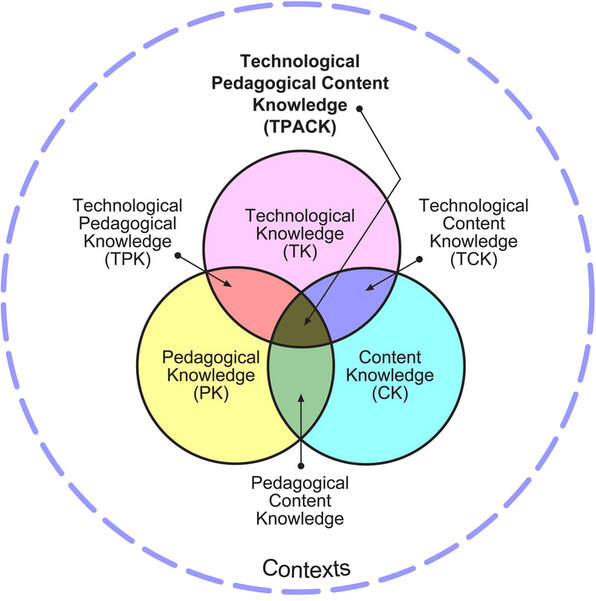 TPACK Image. Adapted from “Using the TPACK Image,” by M. Koehler, May 11, 2011, TPACK.ORG. Retrieved December 8, 2021 from http://www.tpack.org/. Reproduced by permission of the publisher, © 2012 by tpack.org
TPACK model is used to identify the gap in designing an effective teacher training. Obviously the designed teacher training focuses on Content, Pedagogy, and Technology.
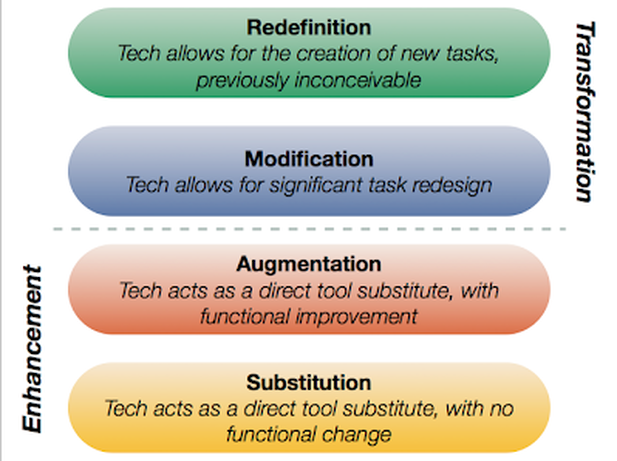 SAMR Image. Adapted from “SAMR for Leadership: Beyond the Basics,” by R. Puentedura, Ph.D. , Ruben R. Puentedura’s Weblog. Retrieved December 8, 2021 from http://www.hippasus.com/rrpweblog/archives/2014/10/29/SAMRForLeadership_BeyondTheBa sics.pdf. http://www.hippasus.com/rrpweblog/archives/000133.html
Clearly, the goal is for the educators to be above the line. This is to offer a transformative education using technology as a means. Moreover student engagement will be higher once technology is used effectively and purposefully.
TPACK x SAMR Let’s use SAMR to gauge the effectiveness in integrating technology in the classroom. While TPACK will be used in identifying which attribute a teacher must be knowledgeable.
Phase 1: SAMR’s Substitution In this phase, this covers an initial trial in using technology for the digital immigrants. As an example for this, instead of an actual board writing of ideas the teacher uses a jamboard in the class, where students freely write their ideas about a certain topic. This is a direct substitution.
Phase 2: SAMR’s Augmentation In this phase, there is direct substitution but with functional improvement. Using the first example above, instead of a jamboard the teacher uses a padlet where everyone in the class can put reactions or comments to someone’s ideas. With augmentation, content, knowledge, and technology are individually tapped as necessity to design a lesson.
Phase 3: SAMR’s Modification Since Modification requires task redesign using technology, this demands a combination of technology and content (TCK), pedagogy and content (PCK), technology and pedagogy (TPK). With the given example, the students may engage in an output driven feedback based on what they have understood from a certain topic.
Phase 4: SAMR’s Redefinition This is the target level of an educator wherein there is a high level of integration of technology, pedagogy, content (TPACK). This demands creating an output that would not only use technology but also exhibits clear understanding of a certain topic.
Thus SAMR and TPACK are two models that can be used to assist educators and administrators on how to effectively transfer knowledge through technology. The pandemic has forced digital immigrants educators who are not comfortable to use technology to finally use it. But has the pre-pandemic teacher training have helped them? Not to generalize but based on observation, teachers during the pandemic have rarely reached Modification and Redefinition (SAMR) in the use of technology in an online classroom. Thus teacher upskilling must be focused on technology and content (TCK), pedagogy and content (PCK), technology and pedagogy (TPK) in TPACK.
With the pandemic, administrators, curriculum experts, and teachers should have reflected on how to close the gap between the expected teacher competencies and available resources in teaching online as a temporary replacement for face-to-face teaching and learning. To some education institutions, online teaching and learning might not be temporary. Some of them started to redesign and offer blended learning.
As a conclusion, the marriage of these two models will continuously challenge educators in different levels of accountability in the education sector. Infrastructure, teacher and learner readiness, and curriculum will be the key factors that need to be met and agreed on. Each education institution must agree on their success indicators based on their existing level of infrastructure, teacher and learner readiness, and curriculum.
References: Alivi, J. (2019). A Review of TPACK and SAMR Models: How Should Language Teachers, Adopt Technology?, Journal of English for Academic and Specific Purposes Volume 2. https://www.researchgate.net/publication/338090115_A_REVIEW_OF_TPACK_AND_SAMR_ MODELS_HOW_SHOULD_LANGUAGE_TEACHERS_ADOPT_TECHNOLOGY
EDUCAARONMESSER (2014, November 9). TPACK or SAMR.Mr Messer Teacher Blog.https://aaronmesserteaches.wordpress.com/2014/11/09/tpack-or-samr/ Onexvad, S. (2013, July 4). Using SAMR to Teach Above the Line. Getting Smart. https://www.gettingsmart.com/2013/07/04/using-samr-to-teach-above-the-line/ http://www.tpack.org/
TPACK Image. Adapted from “Using the TPACK Image,” by M. Koehler, May 11, 2011, TPACK.ORG. Retrieved December 8, 2021 from http://www.tpack.org/. Reproduced by permission of the publisher, © 2012 by tpack.org
SAMR Image. Adapted from “SAMR for Leadership: Beyond the Basics,” by R. Puentedura, Ph.D. , Ruben R. Puentedura’s Weblog. Retrieved December 8, 2021 from http://www.hippasus.com/rrpweblog/archives/2014/10/29/SAMRForLeadership_BeyondTheBa sics.pdf. http://www.hippasus.com/rrpweblog/archives/000133.html
Stay in the loop